English| EUR
Suggested for you
More currencies
Choose a language
Bruges is close enough to Paris that thousands of travellers see it between breakfast and a late dinner, and most of them do it on rails rather than in a coach seat. This day trip from paris to bruges by train guide sets out the practical shape of that journey — where the connection happens, when to aim for Markt, and what the medieval centre actually charges. Everything below is drawn from verified opening and access details rather than estimates.
Quick answer
Yes — Bruges works as a single-day rail trip, and the historic city centre itself costs 0 EUR to enter, with public access running 00:00–23:59 every day of the week. Only individual attractions charge admission. Rail routes from Paris involve one change in Belgium rather than a direct service. Aim for the 09:00–11:00 arrival window; later arrivals coincide with the heaviest coach traffic.
Bruges owes its medieval skyline to an economic disaster. When the Zwin inlet silted up during the fifteenth century, the port lost its channel to the sea, the Hanseatic merchant houses moved to Antwerp, and the city spent close to four hundred years too impoverished to rebuild. What survived that long stagnation is the centre UNESCO inscribed in 2000. It is also why a day trip from paris to bruges by train ends at a destination that asks nothing at the gate: the streets, the squares and the canal quays are free to walk, and only individual museums and towers sell admission. Rail travel here is not a single-seat ride. Services out of Paris run into Brussels, where travellers change from an international train to a Belgian domestic one before continuing west through Ghent. That structure is the real difference between the rails and a guided coach tour. A coach fixes the departure, the lunch stop and the return; a Parijs–Brugge dagtrip by rail hands the timetable back to the traveller, which means the length of the stay and the last service home become decisions rather than givens. Station Brugge stands outside the old ramparts, south of the ring canal, and the approach on foot passes Minnewater and the Begijnhof before the lanes tighten toward Burg and Markt. Because the historic core has no gate and no closing time, the constraint on the day is never opening hours. It is the crowd curve — the mid-morning wave of tour buses that fills Rozenhoedkaai and the Belfry queue, then thins again after the last coach leaves in the late afternoon. Independent rail travellers can sit on either side of that wave; coach passengers cannot. The practical consequence is that the journey, not the destination, deserves the planning attention. Seats on the Paris–Brussels leg are yield-priced and thin out on summer weekends and Belgian public holidays, so the booking pages are worth checking before the rest of the day is fixed. Treated that way, a day trip from paris to bruges by train becomes an exercise in sequencing rather than endurance — arrive inside the quiet window, let the Bruges landmarks absorb the middle hours, and hold the return connection in reserve.
“The destination is free; the journey is the only real expense.”
Traveling from Paris to Bruges requires a rail connection via Brussels. High-speed trains depart from Paris Nord for Brussels, where travelers transfer to a regional service to reach Bruges station.
Eurostar from Paris Nord to Bruxelles-Midi
NMBS/SNCB Intercity from Bruxelles-Midi to Brugge
From Brugge station to Markt
Best arrival window: 09:00–11:00 — Arrive early to avoid the heaviest day-trip crowds and enjoy quieter streets for photography.
This plan suits independent travellers arriving in Bruges within the 09:00–11:00 window, when the streets are still quiet, and it fills roughly seven hours on foot before the return train. Everything below sits inside the compact historic centre, so no transport is needed once you start walking.
Follow the twenty-minute route from the station through Minnewater park and Begijnhof to Sint-Salvatorskathedraal, Bruges' oldest parish church. Doing this on foot in the quiet hour sets your bearings for the rest of the day.
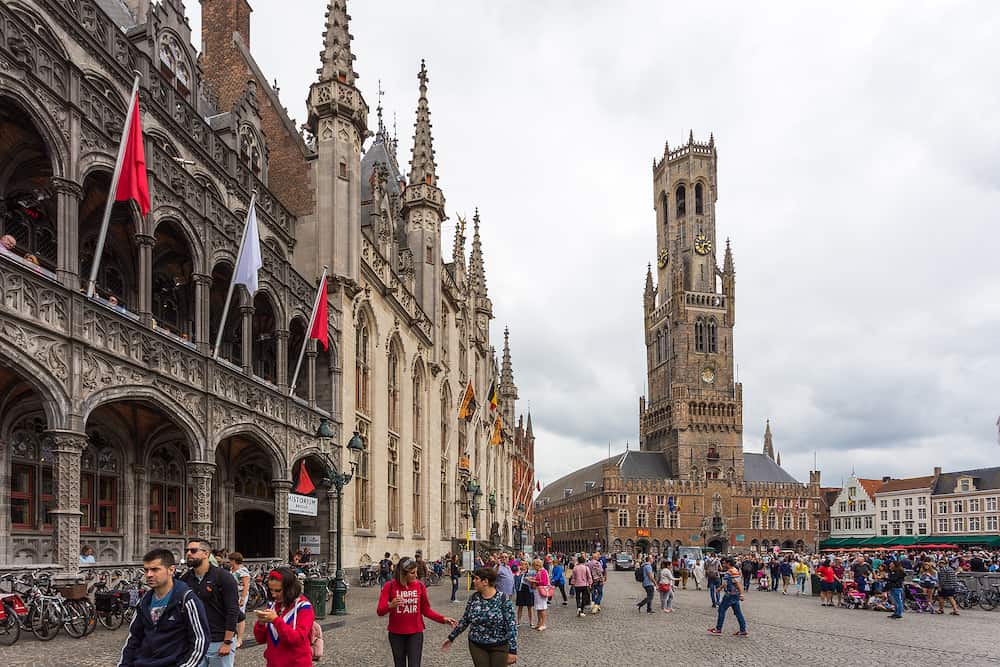
Reach the Markt, the central square at the heart of the old city, and decide early whether to climb the Belfort. The tower admits limited numbers at a time, so the queue grows sharply after midday.
Step one street east to Burg for the Stadhuis facade and the Basilica of the Holy Blood. Allow forty minutes; the upper chapel is small and slow-moving when tour groups arrive.
Walk Rozenhoedkaai, Groenerei and Dijver for the classic canal views. Rozenhoedkaai is busiest between 12:00 and 15:00, so keep moving and return later if you want a clearer shot.
Eat around Sint-Jansplein or Langestraat rather than on the Markt itself. Sit-down service runs an hour, which is worth budgeting rather than rushing.
Choose one, not both. Each takes about ninety minutes at a steady pace, and the Flemish Primitives collection at the Groeninge is the denser of the two.
Head up Kruisvest past the Sint-Janshuismolen for a stretch of Bruges with almost no crowds. Twenty-five minutes each way, and it works well as a slow wind-down.
Retrace through Wijngaardstraat and Minnewater, allowing a full thirty minutes with a stop for chocolate or lace on the way. Aim to be on the platform fifteen minutes before departure.
The best arrival window is 09:00–11:00, allowing you to experience the historic center before the peak influx of excursion groups. Arriving within this timeframe ensures quieter streets for walking and photography.
—
Tuesday through Thursday offer the lowest volume of day visitors.
Mild 10°C to 18°C
Flowers bloom and temperatures remain comfortable for walking.
Cool 11°C to 19°C
Clearer days provide suitable conditions for exploring the canals.
Cold 2°C to 6°C
December crowds increase significantly due to the holiday market.
Verdict: The concrete best slot for your visit is Tuesday to Thursday between April and May or September and October, arriving between 09:00–11:00.
Admission fees for your day trip depend on which specific museums or historic sites you choose to enter. Access to the historic city center of Bruges is free.
Verdict: Most visitors pay 0 EUR to explore the city, with total costs fluctuating based on the number of individual paid attractions selected.
A few things are worth sorting before you leave Paris, since a Bruges day trip runs on tight train times and crosses an international border.
Everything you need to know about day trip from paris to bruges by train
Yes, a day trip from Paris to Bruges by train is entirely possible by taking high-speed rail services from Paris Gare du Nord to Brussels, followed by a connection to Bruges. This route provides a reliable alternative to road-based transport for those exploring Belgian cities.
Arrive between 09:00 and 11:00 to experience the city before the largest crowds descend. This early start allows for quieter navigation of the medieval streets and better photography conditions.
Entrance to the historic city center is 0 EUR as it is a public area. Individual museums or heritage sites within the city will charge their own specific admission fees.
Many visitors arriving by rail choose to book local walking tours to explore the medieval architecture and cobblestone lanes. These services are independent of your transport method and can be arranged once you arrive.
The central hub for navigation is Markt, 8000 Brugge, Belgium. This location serves as the heart of the city and is easily accessible from the railway station.
Yes, you can utilize the high-speed TGV or Eurostar network to reach Brussels before transferring to a local Belgian train. Booking your tickets in advance helps secure the best connection times for your journey.
The city is accessible daily, with official operating hours listed as 00:00–23:59 from Monday to Sunday. While public spaces remain open, please check the specific opening times of individual monuments or cathedrals before your visit.
Traveling by rail offers greater independence and schedule control compared to a guided coach tour. You can set your own pace while enjoying the scenic transition through the Flemish countryside.
The total travel time usually ranges between 2.5 and 3.5 hours each way, depending on your transfer efficiency in Brussels. Frequent rail connections make it possible to spend a full afternoon exploring the canals and historic landmarks.
Pack comfortable walking shoes for the historic cobblestones and a light layer, as weather can shift quickly in this region. You should also bring a portable power bank for your devices to ensure you have constant access to your digital rail tickets and maps.